How to Plan a Multi-City European Trip (Without Losing Your Mind)
Planning a multi-city European adventure sounds dreamy until you’re staring at a map with 47 browser tabs open, trying to figure out if you should fly from Barcelona to Prague or take three trains through the Swiss Alps.
We’ve planned hundreds of European itineraries, and we’ve seen every mistake in the book (including making plenty ourselves). The good news? Multi-city trips don’t have to be chaotic. With the right framework, you can create an itinerary that flows naturally, maximizes your time, and actually feels relaxing instead of like a military operation.
Let’s break down exactly how to plan a multi-city European trip that makes sense.
The Biggest Mistakes People Make
Before we dive into strategy, let’s talk about what NOT to do. These are the planning mistakes that turn dream trips into exhausting marathons.
Trying to see too much, too fast. The classic mistake. You have two weeks, you want to see London, Paris, Rome, Venice, Florence, Barcelona, and Amsterdam. That’s seven cities in 14 days, which means you’ll spend more time in transit than actually experiencing anywhere. You’ll be exhausted, you won’t remember half of it, and you’ll come home needing a vacation from your vacation.
Ignoring geography. Planning Rome to Amsterdam to Paris to Barcelona creates a nonsensical zigzag across the continent. You’ll waste time, money, and energy backtracking when a logical route would have saved you hours of travel.
Underestimating transit time. That “three hour” train ride? Factor in getting to the station early, potential delays, and getting from the station to your hotel. Suddenly your afternoon in the new city has evaporated. Travel days are essentially lost days for sightseeing.
Booking accommodation before finalizing the route. Once you’ve locked in that Venice hotel, you’re committed to getting there, even if it doesn’t make logistical sense anymore. Plan your route first, then book.
Not considering the “vibe shift.” Going from a relaxing coastal town directly into a massive, frenetic city can be jarring. Alternating between different types of destinations helps maintain your energy and enthusiasm.
How Many Cities Is Too Many?
Here’s our general framework, which we use when planning custom European itineraries:
One week trip: 2-3 cities maximum
Two week trip: 3-5 cities maximum
Three week trip: 4-7 cities maximum
The sweet spot for most cities is 3-4 nights. This gives you two full days of exploration plus arrival and departure days. Major cities like Paris, London, or Rome could easily justify 5-6 nights. Smaller towns might only need 2 nights.
A good rule of thumb: if you’re changing hotels more than once every three days, you’re moving too fast. Every time you change locations, you lose half a day to packing, checking out, traveling, checking in, and getting oriented. That adds up quickly.
Our Framework for Choosing Cities and Order
Start with anchor cities
Choose 2-3 “anchor” cities that you absolutely must see. These are typically your major destinations with the most sights, best flight connections, or personal significance. Everything else fills in around these.
For a first-time Europe trip, common anchors might be Paris, Rome, and London. For a Mediterranean summer trip, maybe Barcelona, Rome, and Santorini. (We’ve written detailed planning guides for destinations like Paris and Santorini if you want to dive deeper into specific cities.)
Draw a logical route
Pull up Google Maps. Plot your anchor cities. Now draw the most efficient route that connects them without excessive backtracking. This is your skeleton itinerary.
Does it make a neat loop? Perfect. Does it create a straight line? Also fine. Does it look like a drunken spider drew it? Back to the drawing board.
Fill in complementary destinations
Now you can add smaller cities or towns between your anchors. These should be:
-
Geographically on the way
-
Different in character from your anchor cities (don’t do three massive capitals in a row)
-
Accessible by reasonable transportation
If you’re going Paris to Florence, Lyon or Annecy could slot in beautifully. London to Amsterdam? Bruges is a natural stopover. Always consider whether a detour actually enhances the trip or just adds complexity.
Consider the rhythm
Alternate between intense and relaxed destinations. After a few days pounding the pavement in Rome, a slower-paced Tuscan hill town will feel like a gift. After a beach town, you’ll be ready for urban energy again.
Think about it like music. You need tempo changes to keep things interesting without being overwhelming.
Transportation Strategy: When to Fly vs. Train
This is where people get paralyzed. Here’s how we decide:
Choose trains when:
-
The journey is under 4-5 hours
-
There’s a direct high-speed connection
-
City centers are well-connected to train stations
-
You want to see countryside
-
You have flexibility (trains are easier to change)
Best train routes in Europe: Paris to London (Eurostar), Paris to Amsterdam, Rome to Florence, Madrid to Barcelona, Frankfurt to Munich, Vienna to Prague.
Choose flights when:
-
The distance would be 6+ hours by train
-
You’re crossing to islands or remote areas
-
Budget airlines make it significantly cheaper
-
Time is at a premium
-
You’re covering serious distance (Paris to Athens, for example)
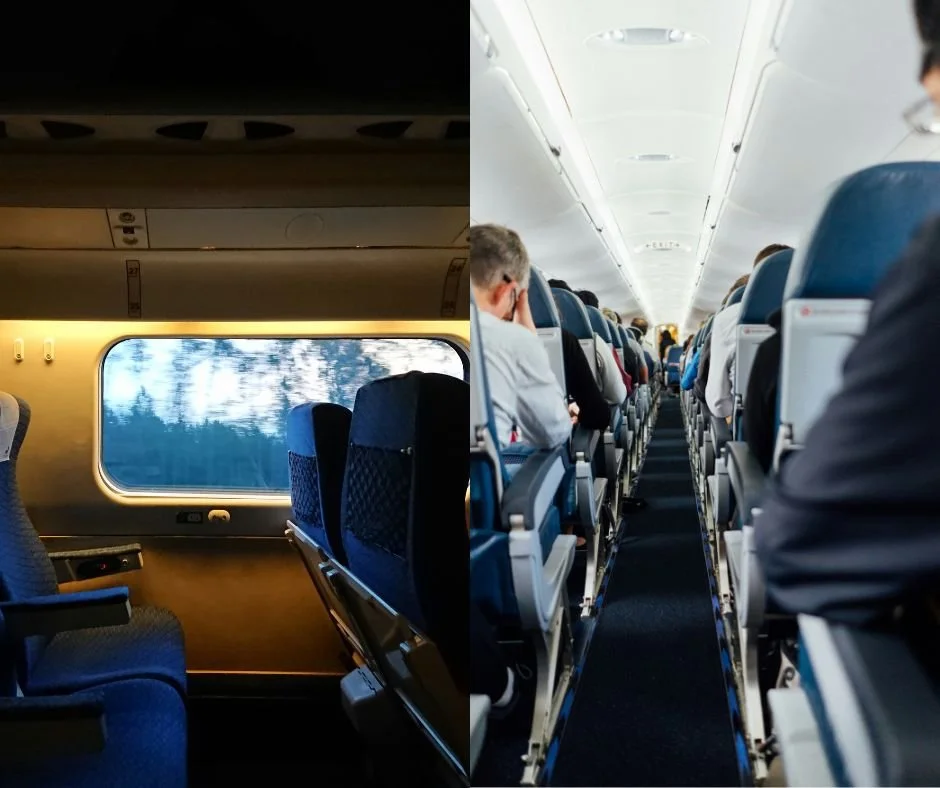
Don’t forget buses. Companies like FlixBus offer incredibly cheap connections between cities. They’re slower than trains but can make sense for overnight journeys or budget-conscious travelers. Just know what you’re signing up for comfort-wise.
A note on budget airlines: Factor in the total cost and time. That $30 Ryanair flight becomes less appealing when you add checked bag fees, the hour-long bus to the secondary airport 40 miles outside the city, arriving two hours early, and the taxi from the arrival airport. Sometimes the $80 train ticket that leaves from and arrives at city center is actually the better deal.
We always use Google Flights and Rome2rio to compare options, and typically book trains directly through the national rail sites or Trainline.
Luggage Strategy for Multi-City Trips
Multi-city trips require a different packing philosophy than single-destination travel. You’ll be moving your luggage often, navigating train platforms, hoisting bags into overhead compartments, and walking on cobblestones.
Pack lighter than you think you need to. Seriously. Going carry-on only for a multi-city trip is game-changing. You’re never waiting at baggage claim, never worrying about lost luggage, and never struggling with a massive suitcase on narrow European streets.
If you absolutely must check a bag, at least keep a few days’ worth of essentials in your carry-on. Lost luggage is more common on multi-city trips with connection flights.
Choose a bag with good wheels. You’ll be rolling it on everything from marble train stations to medieval cobblestones. Spinner wheels are worth their weight in gold.
Pack outfits that mix and match. Stick to a color palette. Bring items that work for multiple occasions. The goal is maximum versatility with minimum volume. We cover this philosophy in depth in our luggage and packing guide.

Sample Routings for Common European Trips
Let’s look at some actual itineraries that work:
Classic Western Europe (14 days)
London (4 nights) → Paris (4 nights) → Lyon or Strasbourg (2 nights) → Munich (3 nights) → Prague (3 nights)
This routing moves generally east, with good train connections throughout. You get a mix of major capitals and smaller cities, urban energy and relaxed charm.
Mediterranean Summer (12 days)
Barcelona (3 nights) → Nice (3 nights) → Florence (3 nights) → Rome (3 nights)
Perfect for a coastal-meets-culture trip. Each leg is manageable, and the route flows naturally along the Mediterranean before cutting inland to Italy.
Italy Focused (10 days)
Rome (4 nights) → Florence (3 nights) → Venice (3 nights)
Sometimes focusing on one country makes more sense than trying to country-hop. This gives you depth rather than breadth, with efficient train connections and a logical north-south route.
Eastern Europe Explorer (14 days)
Vienna (3 nights) → Prague (4 nights) → Krakow (3 nights) → Budapest (4 nights)
Less-traveled but incredibly rewarding. Shorter distances, lower costs, and some of Europe’s most beautiful cities.

Notice what these all have in common? Logical geography, a mix of larger and smaller destinations, and no city gets shortchanged with just one night.
Pacing and Avoiding Burnout
Here’s the uncomfortable truth: you can’t see everything. Trying to do so will make you miserable.
Build in buffer time. Not every day needs to be packed with three museums and a walking tour. Some of our favorite travel memories are wandering aimlessly through a neighborhood, sitting at a cafe watching people, or stumbling into a random local market.
Plan for one “easy” day per week. This might be a travel day that you keep deliberately light, a beach or park day, or just a morning with no alarm. Your body and mind need recovery time.
Don’t schedule anything important the day you arrive or the day you depart. Arrival days are for getting oriented, finding dinner, and shaking off travel fatigue. Departure days are for packing, final walks, and getting to your next destination. Trying to squeeze in major sights on these days is a recipe for stress.
Accept that you’ll miss things. Every city has more to see than you can possibly do. Instead of FOMO, reframe it as a reason to return. We’ve been to Paris a dozen times and still haven’t done everything we want to do there.
Consider your travel style. Are you museum people or food people? Early risers or night owls? Build an itinerary around how you actually enjoy traveling, not how you think you should travel. Our destination selection guide walks through how to match destinations to your preferences.
Making It All Work Together
The difference between a stressful multi-city trip and a smooth one often comes down to logistics. Book accommodations near train stations or city centers. Download offline maps. Keep digital and physical copies of important information like reservations, train tickets, and emergency contacts. (Check out our travel documents guide for a complete checklist of what you need.)
Give yourself permission to adjust plans. Maybe that four-night stay in Prague is so perfect you want to skip the two-night stop in Dresden. Maybe Rome is overwhelming and you’re ready to escape to the countryside early. Flexibility is worth more than a perfect plan.
If you want help pulling all these pieces together, we offer a free custom trip planning service where we handle everything from route optimization to transportation booking to daily itineraries. We’ve built dozens of multi-city European itineraries and can save you the headache of figuring out all the logistics.
Multi-city European trips are incredible. You get diversity, adventure, and the thrill of waking up somewhere new. But they require more planning than single-destination travel. Do the upfront work, follow a logical framework, and pace yourself appropriately. Your future self will thank you when you’re actually enjoying your trip instead of just surviving it.