
Villa vs Hotel vs Resort: How to Choose the Right Accommodation Type
You’ve chosen your destination, roughed out your dates, and started researching where to stay. Then you fall into the black hole of accommodation options. Should you book that gorgeous villa with the private pool? The five-star hotel with impeccable reviews? The all-inclusive resort that promises to handle everything?
Each accommodation type offers fundamentally different experiences, and choosing the wrong one can undermine an entire trip. We’ve planned hundreds of trips across every accommodation category, and we’ve learned that the “best” option isn’t about quality or luxury level. It’s about matching the accommodation type to your specific trip circumstances.
Let’s break down exactly when each option makes sense.
Understanding Your Accommodation Options
Before diving into decision frameworks, let’s define what we’re actually comparing.
Hotels are what most people default to. You book a room (or suite), you get daily housekeeping, there’s a front desk for help, often there’s a restaurant or room service, and you’re paying for service and convenience as much as the physical space.
Villas are entire private homes you rent, typically through platforms like Airbnb, VRBO, or specialized villa rental companies. You get a full house with kitchen, living spaces, often outdoor areas and pools, and significantly more space than a hotel room. Some come with staff (chef, housekeeper, concierge), most don’t.
Resorts are essentially hotels on steroids, usually in vacation destinations, with extensive facilities like multiple restaurants, pools, spas, activities, and often beach or ski access. All-inclusive resorts bundle meals, drinks, and activities into one upfront price.
Boutique hotels deserve their own mention. They’re typically smaller properties (under 50 rooms) with distinctive design, personalized service, and local character. They bridge the gap between large hotels and intimate experiences.
The lines blur sometimes. You’ll find villa-style accommodations at resorts, boutique properties that feel like private homes, and luxury hotels with villa sections. But understanding the core categories helps clarify what you’re actually choosing between.
When Villas Make Perfect Sense
Villas shine in specific circumstances. Here’s when they’re often the best choice:
Groups and families traveling together
This is the obvious one. Four couples sharing a villa in Tuscany, an extended family gathering in the Caribbean, a friend group renting a house in the South of France. The math suddenly works in your favor.
A luxury hotel might run $400-600 per room per night. Four rooms means $1,600-2,400 per night. A stunning villa that sleeps eight might cost $1,000-1,500 per night total, with significantly more space, privacy, and a kitchen that actually saves money on meals.
Beyond cost, villas give groups communal space. You can cook breakfast together, hang out by the pool, have dinner on a terrace overlooking the vineyard. Hotels force you into your separate rooms or the lobby. Villas let you actually spend time together.

Longer stays (one week or more)
After about five days in a hotel room, even a nice one, you start feeling confined. You’re eating out for every meal. You can’t do laundry. There’s nowhere to actually relax except the bed or a chair.
Villas for longer stays provide the rhythm of normal life. Make coffee in the morning. Do laundry mid-week. Cook dinner a few nights. Spread out your stuff. It’s the difference between living somewhere temporarily and just sleeping there.
We generally recommend considering villas for stays of seven nights or longer, especially in destinations where eating out every meal gets expensive or exhausting.
Destinations where you want a “home base” experience
Some trips are about exploring from a central location rather than being in the thick of things. A villa in the Tuscan countryside makes perfect sense when you’re planning day trips to hill towns and vineyards. A house on the Amalfi Coast works when you’re driving the coastline and want a peaceful retreat.
The villa becomes your sanctuary between adventures rather than just a place to sleep.
When you value privacy and space above service
Some people just prefer having their own private domain. No one walking past your door, no housekeeping knocking, no lobby to cross in your bathing suit. If that resonates with you, villas deliver.
When you have specific needs a hotel can’t meet
Traveling with small children who need early bedtimes (while you want to stay up)? A villa with separate bedrooms solves this. Have dietary restrictions that make restaurant meals difficult? A kitchen gives you control. Need to work remotely with space for Zoom calls? Villa layouts provide options hotels can’t match.
When Hotels Are the Better Choice
Hotels aren’t just the default option. They’re actively better for many trip types.
Solo travel or couples without kids
The villa math falls apart when you’re just two people. You’re paying for space you won’t use. You’re managing a whole house when you’d rather just have a comfortable room. The kitchen you’re paying for sits empty when you want to experience local restaurants.
For solo travelers and couples, hotels usually offer better value for the actual experience you want.
When you want service and don’t want to manage logistics
Hotels handle everything. Fresh towels appear. Beds get made. The front desk books your dinner reservation and arranges your car. Concierges provide recommendations and solve problems.
Villas, even luxury ones with staff, require more management. You’re coordinating with the owner or property manager. You’re figuring out how things work. You’re the one responsible if something breaks or goes wrong.
If you want someone else to handle the details so you can just enjoy your trip, hotels deliver that experience far better than villas.

City destinations and short stays
For three nights in Paris, Barcelona, or Tokyo, a hotel in a great location beats a villa every time. Cities are about being in the middle of things, exploring neighborhoods, and eating at restaurants. You don’t need a kitchen or a living room. You need a comfortable place to sleep and a location that minimizes transit time to what you actually want to see.
Short city breaks call for hotels, period.
When location is absolutely critical
Hotels, especially in cities and resort areas, secure the prime locations. They’re in historic centers, on the best beaches, with walkable access to attractions. Villas, particularly in popular destinations, are often farther out where properties have enough land for houses with pools and gardens.
If being in the exact right location matters more than space or privacy, hotels win.
When you’re destination-hopping
If you’re spending three nights in Florence, two in Rome, and three in the Amalfi Coast, hotels make far more sense than bouncing between villas. The check-in/check-out process is streamlined, you’re not managing multiple property managers, and you’re not paying villa cleaning fees for super short stays.
Multi-city trips almost always call for hotels. (We cover this more in our European trip planning guide.)
When you want amenities you can’t replicate
That infinity pool at the Ravello hotel, the spa with incredible treatments, the restaurant with a Michelin star, the rooftop bar with sunset views. Hotels offer facilities and experiences that individual villas simply can’t match.
The All-Inclusive Resort Reality Check
All-inclusive resorts are polarizing. People either love them or avoid them entirely. Here’s who they’re actually for (and who should skip them).
All-inclusives make sense when:
You want maximum predictability and minimum stress. Everything’s paid upfront. You know exactly what you’re spending. There are no decisions to make or surprises. For some people and some trips, that’s incredibly appealing.
You’re traveling with kids. The kids’ clubs, family-friendly activities, safe environments, and multiple food options make all-inclusives genuinely easier for families. Parents can relax knowing kids are entertained and fed without constant negotiations.
You genuinely want to stay on property. If your ideal vacation is reading by the pool, taking a yoga class, eating lunch, going to the beach, having a spa treatment, and never leaving the resort, all-inclusives deliver exactly that experience. Some people want that, and that’s completely valid.
Budget certainty matters more than optimization. You’re not trying to find the best local restaurant or the hidden beach. You want to know your costs upfront and not think about money for a week. All-inclusives deliver that.

Skip all-inclusives when:
You want to experience the actual destination. All-inclusives are designed to keep you on property. Leaving means abandoning the value you’ve already paid for. If you want to explore local towns, eat at local restaurants, and experience local culture, all-inclusives actively work against that goal.
You care about food quality. With rare exceptions (some luxury properties in Mexico and the Caribbean do food well), all-inclusive food is mediocre. It’s buffet-style, mass-produced, and optimized for volume over quality. If meals are important to your travel experience, you’ll be disappointed.
You value authenticity. All-inclusive resorts create a bubble separate from the actual place you’re visiting. They’re the same in Jamaica as they are in the Dominican Republic as they are in Mexico. If you care about experiencing actual Jamaica or actual Mexico, don’t stay at an all-inclusive.
You like flexibility and spontaneity. Once you’re committed to an all-inclusive, you’re anchored there. The sunk cost pushes you to stay on property even when you might prefer to explore, try that restaurant someone recommended, or take a day trip.
Boutique Hotels vs. Chain Luxury
This deserves its own consideration because it’s a meaningful choice that shapes your experience.
Chain luxury hotels (Four Seasons, Ritz-Carlton, Aman, etc.) deliver consistency, impeccable service standards, and facilities that smaller properties can’t match. You know what you’re getting. The service is professional. Everything works. These make sense when reliability and full-service amenities are priorities, or when you’re in destinations where you want that safety net of international standards.
Boutique hotels offer character, design, local flavor, and often more personalized service. They feel unique rather than predictable. You’re staying in a restored palazzo in Italy or a design-forward property in Japan that actually reflects where you are. The trade-off is sometimes less consistency, fewer facilities, and occasionally quirks that chain properties would never allow.
We generally lean toward boutique properties in destinations where that local character enhances the experience (most of Europe, Japan, interesting parts of Asia and Latin America) and toward chain luxury in destinations where reliability and facilities matter more (remote locations, business travel, anywhere we want guaranteed service standards).
Our hotel research guide walks through how to evaluate both types.
Cost Comparison Framework
Let’s talk real numbers. Here’s how to actually compare costs across accommodation types:
For hotels:
Room rate per night × number of rooms × number of nights, plus meals out × number of people × number of days, plus incidentals (drinks, room service, etc.)
For villas:
Nightly rate × number of nights, plus cleaning fee, plus any service fees or booking fees, plus groceries and cooking supplies, plus any meals out you still plan to have
For all-inclusive resorts:
Per person rate × number of people × number of nights, plus anything not included (premium drinks, off-property excursions, spa treatments, specialty restaurants)
The trick is being honest about how you’ll actually behave. That villa might save money if you really do cook most meals. But if you end up eating out constantly anyway, plus paying for the villa, you’ve spent more than a hotel would have cost.
Similarly, all-inclusives look expensive upfront, but if you’re the type to order room service, hit the hotel bar, and eat three meals out daily, the all-inclusive might actually be cheaper.

Run the real math for your specific trip. We cover this more thoroughly in our guide on the real cost of travel.
Our Decision Framework
Here’s the decision tree we use when planning trips:
Start with the basics:
-
How many people are traveling?
-
How long is the trip?
-
What’s the primary destination type (city, resort area, countryside)?
-
What’s the trip purpose (relaxation, exploration, celebration)?
Then narrow by circumstances:
1-2 people, short trip (under 5 nights), city destination → Hotel, probably boutique if available
3+ people or 7+ nights, vacation destination → Seriously consider a villa, especially if traveling with family or friends
Family with young kids, wanting simplicity and predictability → Consider all-inclusive resort or hotel with family facilities
Couples seeking luxury and service, any destination → High-end hotel or resort, boutique where possible
Group celebration (anniversary, milestone birthday, reunion) → Villa for communal space, or hotel if the destination itself is the draw
Multi-city trip → Hotels throughout for simplicity
Working remotely while traveling → Villa for space and kitchen, or hotel with good work facilities
Destination where local experience matters greatly → Hotel or villa, never all-inclusive
Real Examples From Actual Trips
Let’s look at how this plays out in practice:
Tuscany, 7 nights, 2 couples
Our choice: Villa
We found a restored farmhouse between Montepulciano and Montalcino with four bedrooms, a pool, and vineyard views. Cost was about $2,500 for the week. Split between two couples, that’s $625 per couple total, or about $90 per night per couple.
Comparable hotels in the area run $250-400 per night per room. The villa saved significant money while providing better communal space, a kitchen for breakfasts and some dinners, and that “living in Tuscany” experience rather than just visiting.
This is a textbook villa scenario: multiple nights, multiple couples, countryside location, part of the experience is being in a beautiful space rather than just sightseeing.
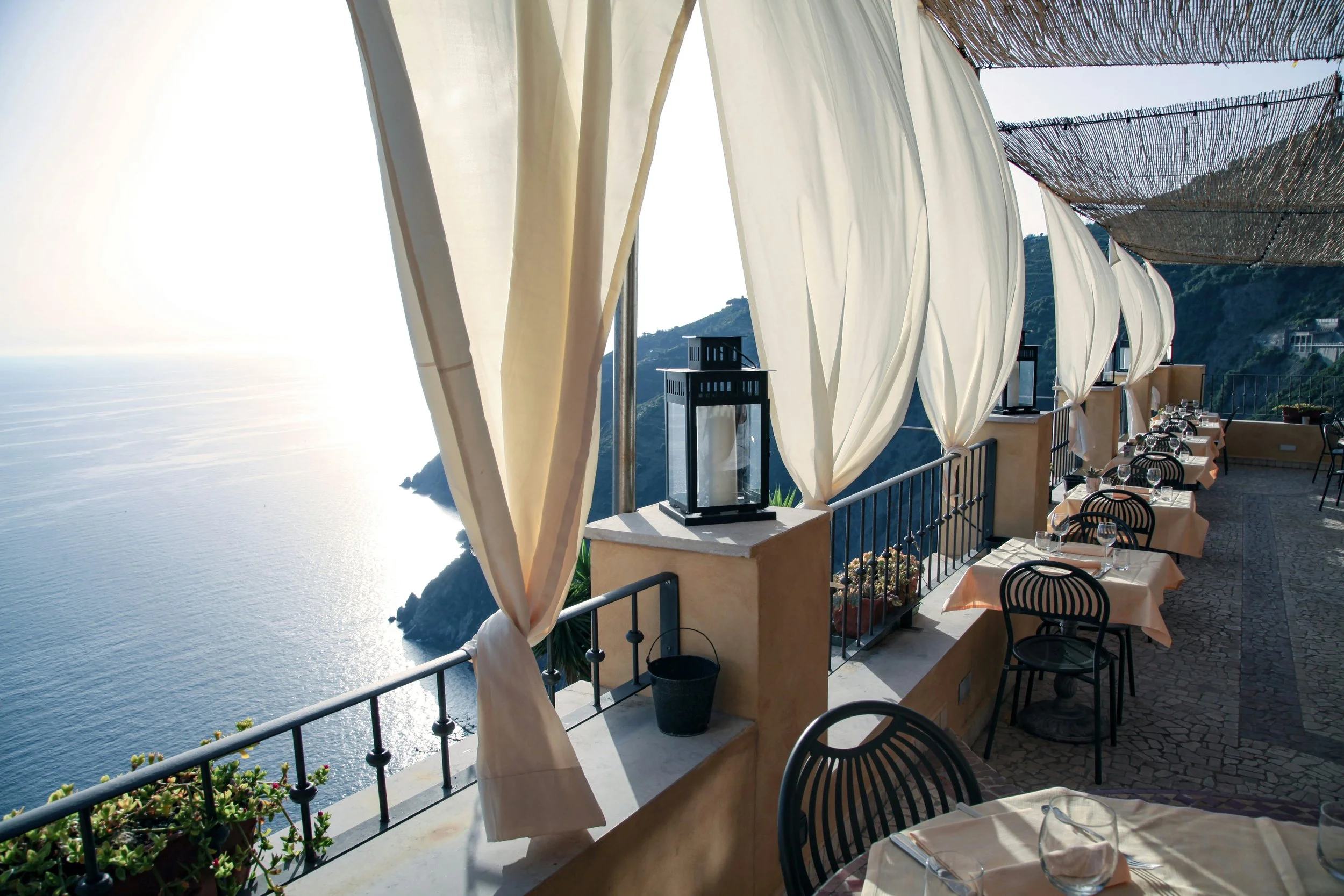
Amalfi Coast, 5 nights, couple
Our choice: Hotel
We chose a hotel in Positano with incredible views, rooftop breakfast, and a prime location. Yes, it was expensive ($600/night). But we wanted to explore the entire coast, take day trips to Capri and Ravello, eat at different restaurants each night, and have someone handling logistics in a place where logistics are genuinely challenging.
A villa would have been cheaper, but we would have missed what we actually wanted from the trip. The hotel location meant we could walk to everything in Positano, the ferry dock was five minutes away, and the staff handled our driver arrangements and dinner reservations. (Our full Amalfi Coast guide covers why location matters so much there.)
Caribbean, 6 nights, family with three kids
Our choice: All-inclusive resort
The parents wanted a true break. The kids ranged from 6 to 13. An all-inclusive with excellent kids’ clubs, multiple pools, beach activities, and varied food options made perfect sense.
Total cost was actually similar to what a villa would have been once we factored in groceries and activities, but the all-inclusive meant the parents could actually relax instead of managing meals and entertaining three kids in a house all week.
Not every trip needs to be about experiencing “authentic” local culture. Sometimes it’s about giving parents a break and letting kids have fun. All-inclusives serve that purpose well.
Barcelona, 3 nights, solo
Our choice: Boutique hotel
A small design hotel in the Gothic Quarter, walkable to everything, with a great breakfast and helpful staff. Solo travel in a city calls for hotels, full stop. The boutique choice reflected wanting to stay somewhere with character that felt connected to Barcelona rather than an anonymous chain property.
The location meant I could walk to La Boqueria market for lunch, explore different neighborhoods easily, and have a comfortable base that didn’t require managing anything.
Making Your Final Decision
Stop agonizing over whether there’s one “right” answer. There isn’t. The best accommodation type for your trip depends entirely on your specific circumstances, priorities, and travel style.
Ask yourself these questions:
-
What experience am I actually trying to have on this trip?
-
How much do I value service vs. space vs. cost savings?
-
Will I really use that villa kitchen, or am I fantasizing about cooking when I’ll actually eat out?
-
Does this destination call for being in the center of things or having a retreat?
-
Am I willing to manage more logistics for cost savings?
-
What would actually make this trip feel most relaxing or enjoyable for me?
Be brutally honest with yourself about how you actually travel rather than how you imagine you travel. If you’ve never cooked on vacation before, don’t pick a villa because you think you’ll suddenly start cooking in Provence.
If you’re still unsure or want help thinking through the options for a specific trip, that’s exactly what our trip planning service is for. We help clients navigate these decisions all the time, considering all the factors that actually matter for their specific circumstances.
The accommodation you choose shapes your entire trip experience. It’s worth taking time to get it right.